Showing posts with label church. Show all posts

Saturday, February 27, 2016

On Accidental Saints

Last year (2015, for those keeping track) at Lent, my church picked two books for the Lenten book group. One was Accidental Saints, by Nadia Bolz-Weber, and the other was Desmond Tutu's Made for Goodness. Well, I was in college up to my eyebrows, and the book group ended up not having its last meeting, and I got severely behind in my reading. I didn't pick up either book again. Here are my first and last posts on the books.

The rest of this has spoilers, so, if you're not into spoilers for Accidental Saints, you should stop reading here.

So, now that college is all but over and I have more spare time, I went ahead and finished Accidental Saints. You can check out my review on GoodReads, but I wanted to add something that really struck me about the last 3/4 of this book. It was the chapter that dealt with Nadia's friend Bruce's drunk driving accident.

Nadia had befriended Bruce, a Bishop in the Lutheran church, whose wife was dying of cancer. Some years later, something bad happens. Nadia writes,
"In a brief exchange on instant message, I learned that, two nights earlier, Bruce got behind the wheel of his car with what tests would later show to be a higher than legal blood-alcohol level, lost control, and hit and killed a fifty-two-year-old mother of three. And by the time I found out, from my luxurious room in a resort in Mexico, Bruce was sitting alone in jail."
This chapter so spoke to me. I still often think of my bishop, who also got behind the wheel of her car with what tests would later show to be a far higher than legal blood-alcohol-level, wasn't paying attention, and struck and killed a 41-year-old father of father of two.

It was hard to know what to pray for - Tom Palermo, his family, and cyclists everywhere, or my suffragan Bishop Heather Cook, her family, and prisoners everywhere. Of course I prayed for all of the above. I wrestled with anger at the bishop, I wrestled with disappointment in a church leader, I worried about the divide this might drive between often liberal-atheist-cyclists and drivers and the church.

Nadia talks in this chapter about the need for mercy and the remorse Peter must have felt as he swam up to Jesus and proclaimed three times that he loved him. She writes, "We simply have to cling tightly to the truth that God can redeem it." I'm still struggling with that one.

I know Jesus being resurrected is supposed to make it all okay - that the resurrection makes everything okay. It washes away all our sins - as Nadia might say, mine, yours, Heather's, Peter's. But that's hard to swallow. It's hard to not still feel a little angry and a little lost and a little heartbroken.

Sunday, November 8, 2015

On Accidental Saints and Made For Goodness - Week 2

On Perfection

I have to say, Nadia's chapter where she talked about the expectations of others really spoke to me. She said, "Maybe it's not only the leaders who think they should be perfect; maybe it's also their followers who expect them to have it all together."

I am totally guilty of this. Like, all-the-time guilty. I have high expectations of myself, and high expectations of others. I tend to know my friends well enough to love them and their imperfections. I love their snarky-ness, their sarcasm, their occasional falling-apart. I identify with all those things, and I do them myself. I know we're not perfect.

But I expect my leaders - in family, in church, at work - to be always forgiving, never snarky, never falling-apart. At least, not when I'm around. I have some amends to make, and I'll make them in person.
Desmond Tutu again echoes her: "As human beings, we hear in the command to be perfect a demand for flawlessness. But flawlessness is not the goal of God's invitation. ... Godly perfection is not flawlessness. Godly perfection is wholeness." I love him for saying this. I guess I have some work to do.
Desmond Tutu talks about practicing being good. He talks about how God gave us choice, but the choice really is ours, and it does take practice. I have to admit, this really confused me. Last week, he was saying that being good is something we are, not something we do, and now he's saying that we have to practice being good.

Not the Blessing

The other thing Nadia said that really struck me, was when she talked about how we are not the blessing that is bestowed upon others. I'm guilty of this one, too. Thinking that I will magnanimously step down from my ivory tower and bless people with my presence or my works. She points out that we are all both needy and needs-meeters. It was a difficult concept to wrap my head around. I think she's also saying that experiencing the need and the meeting of that need is to experience Jesus. It's not in the being needy or in the generosity - it's in the communion.

The Discussion Questions


  1. 1. What is your Nineveh? Has God ever moved you to confront that thing, person, or event that you would rather avoid? What happened, and how did it feel?

    Not so much, on this one. I would say that the closest it comes is at work. As a team-lead, I was a great coach, mentor, cheer-leader. But I wasn't good at giving negative feedback or conducting sessions where I had to counsel someone on poor performance. I had to do it, and it felt awful. I'm still much better at "A for effort!" than I am at "these are the expectations. Let's find a way for you to start meeting them."

  2. Have you ever felt like you were someone's "project" - as if they were trying to "minister" to you, yet somehow were serving themselves? How did it feel? Why is it so difficult for us to give to others without becoming self-important?

    Again, not so much. I've definitely been on the other side of that - believing that I could lead a youth group (I don't even like kids!) because I was young and energetic (I was) and I understood teenagers (nope. Not even when I was one). It was a gift I didn't and don't possess, and I failed miserably. I think we do better at ministration when it's in a way that comes more naturally.

  3. (Summarizing) When you were young, did you believe that Godliness meant following a list of prohibitions? ...Has that rules-based messaging affected how you live and feel as an adult? Is there such a thing as "Godly living"? Is the lifestyle and personality of the Christian the primary focus of faith?

    Oh, yes. Christians don't smoke, drink, smoke pot, swear, have pre-marital sex. I know now those things aren't true, but when I was a teenager, I vacillated between believing that we are saved by faith and that we are saved by works. When I thought we are saved by works, I was super-puritan. When I thought we are saved by faith, I took it as a free pass - I'm already saved, I can do whatever the hell I want. Now, I think it's both. I do still believe that we should aim for a lifestyle that treats ourselves and those around us well. I know that as sinners, we'll fall short. But I do believe we should be trying.

Tuesday, October 27, 2015

On Accidental Saints and Made For Goodness - Week 1

I can't always make it to church, and that means missing book group. So I'm participating via blog, at least on the weeks I can't make it.

Overall Impressions

The choice to read these two books together was brilliant. They echo each other using different voices for much the same message, and it's a good and powerful message. So far, I'd say the message is, "You are worthy - it'll be okay."

Nadia Bolz-Weber's voice in Accidental Saints - Finding God in All the Wrong People is humorous, at times irreverent. She uses swear words! She sounds like someone I'd like to have coffee with. It's refreshing to "hear" someone speak on Godly matters without the lofty speech that often makes books on the subject inaccessible to the average Joe.

Desmond Tutu's voice in Made for Goodness and Why This Makes All the Difference is grandfatherly. Kind, approachable, instructive. His text is a little denser than Nadia's, which is why I think it's a good thing that we typically read three chapters of her book to two of his. He has a much different outlook than Nadia (for some obvious reasons), but still manages to relate to the American experience.

What Spoke to Me

One of the best quotes from Accidental Saints is: "There is nothing we have done that God cannot redeem." It's really hard to internalize this one. Tutu helps a bit: "God already loves us perfectly; God cannot love us one iota more. Equally, there is nothing we can do that will make God love us one iota less." This, too, is difficult to internalize, but remembering God's love is perfect is helpful.

The next quote from Accidental Saints captures the idea that we are all complicated. I think this speaks to the idea that we're all marred by sin in some way, but also reflects the idea that we're all saints, too: "On All Saints' Sunday, I am faced with sticky ambiguities around saints who were bad and sinners who were good." This pairs nicely with one from Made for Goodness, which reminds us that even though we are all complicated, we're also all good: "There is not a single person that God gives up on, because God knows that we are made to be like God, who is goodness itself."

Nadia talks about her struggles with racism, and that resonated with me. She says that for all her anti-racism talk and liberal leanings, she can't get around the fact that she reacts differently to (for example) young black men she sees on the street. She also references white privilege and her empty outrage at the inherent racism in our society. She says she feels that if she could just "show the right level of outrage, it'll make up for the fact that every single day of my life I have benefited from the very same system that acquitted George Zimmerman." Tutu has a slightly different take on it: "If wrong was the norm, it wouldn't be news... Murder and mayhem are not the norm. The norm is goodness." This brought me hope. It's easy to feel discouraged watching the news. Whether it's local stories or international news, there are atrocities everywhere, and there's so much of it I can't do a thing about. I like this reminder that while it may seem that stuff is everywhere, there's also goodness everywhere. It's almost like he's speaking to her outrage, here.

Desmond Tutu devotes a lot of time to explaining that our efforts to "be good" get in the way of our recognition that we "are good." One of the things he says is, "Attached to that notion of "being good" are all the "oughts" and "shoulds" that we think will win us... God's love and divine favor." I've been in therapy a few times. One of the more recent was because of the stress I was facing with accepting a decision that meant our family was geographically spread out, and I was (temporarily) a single mom. I had stopped sleeping. I had almost stopped eating. I was consumed by anger and stress. The therapist worked with me using cognitive behavioral therapy - changing your thinking in order to better control your thinking. He talked about "musterbating" - allowing too many toxic thoughts into your head. "It must be fair" (no, it isn't always fair), "I must do the dishes" (no, you don't have to do the dishes, but maybe there's a way to remind yourself that you want to), "I must be understood" (nope, that doesn't always happen, either). Focusing on that stuff will drive you certifiably crazy. Tutu also said, "We cannot choose how we feel. We can choose what we do, how we act." I'm not sure I agree with this. I think you can make choices about how you feel. I think my therapy did just that. I think when we are angry, that's as much a choice we make as when we decide to move forward from a set-back.

One of the first things I highlighted from Accidental Saints was a quote about the saints in our lives: "Saint Paul describes the saints as "a great cloud of witnesses," so when they have passed, we still hold them up, hoping perhaps that their virtues... might become our own virtue, our own strength." I had never considered our (Episcopal) view of the saints in this light, but I like the idea. It was an "aha!" moment.

There's this, on leadership, from Accidental Saints: "I'm a leader, but only by saying, 'Oh, screw it. I'll go first.'" I wonder how much of corporate leadership is this "Fine - I'll go first" kind of attitude and how much is "We (meaning you) need to go this way." Is one way better in the corporate world? More effective? Is there room for high-level corporate leaders to "go first"? I'd like to say that going first is the best leadership... But honestly, I'm not sure the guys at the top can do that. Not in any "corporate vision" kind of way. Maybe they can sometimes. I don't know.

The Discussion Questions

1. I rarely think of myself as a saint. Mostly, I realize how broken I am - I'm so mean, sometimes. Often, even. I've said before that if my mom, my aunt, and my husband are praying for you, you're going to be okay. While each of these people is merely human - they each have their flaws - I also know that they can be my strongest supporters. I've always felt their spiritual health was really high, even when they were in crisis or questioning their faith.

2. I think I'm often in places where I say the wrong thing, or I react the wrong way. I think loving (in a Christian kind of way) the people around you helps you empathize with them more, and might help you not say the wrong thing, but I think getting it right 100% of the time is impossible for humans. I think Desmond Tutu answers this better, by encouraging us to not try to say the right thing or do the right thing, but to remember that we are good, even when we're not.

3. Figuring out just what crap I've had exchanged for Jesus's blessedness is pretty hard. I know I've got a lot of crap. Figuring out which has been more or less directly exchanged is a tall order. I suppose, I could say that there have been a few times when I said exactly the wrong thing to someone... And those people chose to keep talking to me, to be my friends, to forgive me. I guess that's my crap for His blessedness.


Saturday, October 24, 2015

The Big Deal About Some Washington, D.C. Bike Lanes

If you're following me on Facebook, you've already seen most of this. This post lays out the background information, both sides of the argument, and my stance in it.

The Current Situation:

There are bike lanes all around this piece of Washington, D.C., but few that connect the areas with a lot of bike lanes to the areas with few bike lanes, and fewer continuous north-south bike lanes nearby. The marker is for New York Ave. and 6th street, northwest. Solid lines are bike lanes, dotted lines are "bike-friendly streets" - places where Google has noted there are bicyclists, though I question their equation of large numbers of cyclists to "friendliness." 6th street is like a bike-lane desert.

In 2014, 12 bicyclists and 16 pedestrians were hit along the stretch of 6th street under consideration, and 14 bicyclists and 7 pedestrians were struck along the portion of 9th street under consideration, according to FOIA data cited by the Washington Area Bicyclist Association (WABA). So, bicyclists and pedestrians do use the street, but not safely.

On 6th street and M street (jut north of the marker on the above map) is a large church of long-time congregants, the United House of Prayer. The New Bethel Baptist Church is at 9th and S. Northwest D.C. has seen a lot of gentrification.

The United House of Prayer enjoys street parking, where about 75 cars can park diagonally on Sundays. The proposed changes to 6th street would allow only parallel parking, meaning the loss of an unknown number of parking places.

The Proposals:

There are four proposals for adding bike lanes to either 6th or 9th streets in northwest Washington, D.C. They all allow for some street parking, at least at "non-peak" times, which would presumably include Sunday mornings.

Here's my favorite proposal, which provides for protected bike lanes in each direction, two or four lanes of travel (four in peak times), and 2 lanes of parking during non-peak times. The plan for 6th street north of New York Avenue looks the same as this, which shows 6th south of New York Avenue:

The Conundrum:

Gentrification has forced many of the congregants to the suburbs. The churches may see a concerning situation where congregants are far from their church and have trouble parking once they get there. They are arguing that this loss of parking impinges on their freedom of religion.

The city has adopted Vision Zero, which aims to eliminate traffic deaths. Protected bike lanes are a major portion of this vision.

The Washington Area Bicyclist Association (WABA) asserts in their post on the recent public meeting that while concerns about gentrification are valid, using the proposed bike lanes as a proxy for this argument is inappropriate.

My Stance:

As Christians, we are told to protect the vulnerable. This extends to vulnerable street users, such as bicyclists and pedestrians. The benefit of being "strong" (in the majority, supported by your environment, and physically secure) is that you can afford to help the weak. As Christians, we are commanded to do so, even at the expense of our comfort.

As Christians, we are told that we are the stewards of our environment. While biking isn't free from environmental harm (tires are a petroleum product), it is more responsible than driving. As Christians, we should be encouraging bicycling and walking as means of transportation.

As Christians, we are told to love one another, above all else. The importance of community and inclusiveness is reinforced through scripture. Our public policies and behaviors should reflect these values.

Unfortunately, the behavior of the those representing the churches at the public meeting did not represent Christian values. Besides holding their right to park above others' right of physical safety, they shouted down and cat-called opposing viewpoints.

I hope that should my church find itself in a similar situation, that we will demonstrate the Christian values we claim as our own.

Sunday, June 23, 2013

Of Demons and Pigs

This Sunday's Gospel reading was Luke, chapter 8, verses 26-39. As a refresher, this is the one where Jesus  meets the man who is possessed by demons, who beg Jesus for mercy (not to torment them; to not send them into the abyss). Jesus agrees to let the demons go into a herd of pigs, and when they do, the pigs all run off a steep hill into the lake and drown. The townspeople get freaked out and ask Jesus to leave.

The priest's sermon on this talked about the different kinds of demons, and how we all have them; internal and external demons. As he talked about the internal demons, how they can cause you to speak with a voice that is not your own (as they did in the reading, answering Jesus's questions), I couldn't help but remember The Bloggess's admonition: depression lies (probably at least in part because whenever I think of depression, I think of her wonderful mantra). I had never thought of the lies being in the form of things you say that aren't you - that the lies depression tells aren't  just  "you're not good enough" or whatever version of that you hear, but that it steals your own voice to tell others lies, too.

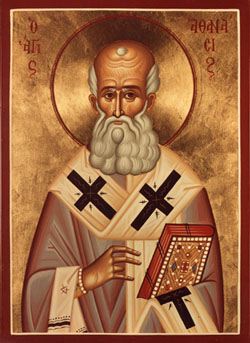
I love it that this particular priest quotes long-dead saints. Today he quoted (among another) Athanasius as saying (I paraphrase) that demons have no power, even over swine. That goes very well with the Islamic image of the devil as the Whisperer, unable to enact real evil, but who plants evil thoughts in our heads. The Islamic concept of the devil is one I really appreciate. It's much more relatable than the large, evil beast of Hell: We all hear evil whispers now and again.

And that goes right into the next point that this priest made that I loved: That Evil has no real home in God's universe. The demon(s) begged Jesus not be to sent back to the abyss, the void. Any home Evil finds is only a false home - one from which it can be expelled.

So, I have more weapons to add to my arsenal.
Depression lies.
Demons don't belong here.
Demons have no power here (so long as I remember not to give them any).

Sunday, June 2, 2013

Just Like That, Huh?

The Old Testament reading at church today was from 1 Kings, bits and pieces from chapter 18.

In a nutshell, Elijah goes to the Israelites and says, "You all are worshipping a false god, Baal. We'll see which god is the real God. We'll each prepare a bull for sacrifice, and whichever god can burn his own offering we'll all agree is The God. You guys go first." So they slaughtered a bull and prepared it, but didn't light it on fire, and started praying to Baal. They prayed fervently all dang day, but nothing. Elijah taunted them, and they cut themselves according to their tradition and still, Baal never showed up to burn the offering. Elijah slaughtered a bull and prepared his offering, but doused it in water first, like, really drenched it. And he prayed, and God showed up and burnt the offering thoroughly, even the water burned.

When all the people saw it, they fell on their faces and said, "The Lord indeed is God; the Lord indeed is God." We didn't read the next bit, about Elijah slaying all the prophets of Baal. (1 Kings 18:39)

I'm thinking, How awful would that be?

So, you watch as your god gets beaten soundly in a whose-god-does-better-fire contest, your community leaders get schwacked by the victors, and you, what, fall down acknowledging the power of the new God, and get back to your life? Just like that? Just, bam!, yesterday we were Baalites, now we're Jews.

There wasn't one guy that called for a do-over? There wasn't some goodwife back home, saying, "well, you men probably didn't do it right. Baal's there, you just messed up the offering." Or, "Baal's a perfectly good god, but he demands we follow the rules he gave us, which include burning the offering. You want the god, you gotta follow the rules."

And isn't that, in essence, what God (via Elisha) does in 2 Kings chapter 5? He (again, through Elisha) cures the captain of leprosy, but only if he goes and bathes seven times in the Jordan. Not the Abana or the Pharpar, but in the Jordan. Again, you want God, you gotta follow the rules.

I don't want to get into a discussion on whether or not we really have to follow the rules, or what exactly the rules are, or anything like that. My point is, isn't that kind of harsh? And more than a little hypocritical?

Saturday, April 27, 2013

Prayers For Peace and Reconciliation

Each church has it's own "flavor" - special touches specific to that church, even if the church is a liturgical one. One of the first things I noticed about our new church - one of the things that made me fall in love with it - is the bit at the end. At this church, after the post communion prayer, after the thanksgiving for birthdays and anniversaries, we all say the Prayer For Peace:

O God, the Father of all, guide us into the ways of peace. Lead us from prejudice to truth; deliver us from hatred, cruelty, violence, and mean spiritedness; fill us with generosity, hospitality and love, and in your good time enable us all to stand reconciled before you, through Jesus Christ our Lord. Amen. 

And then there's more (maybe the birthdays and anniversaries are here instead of before? I can never remember). We all say the first part of The Final Blessing:

Go forth into the world in peace; be of good courage; hold fast to that which is good; render to no one evil for evil; strengthen the fainthearted; support the weak; help the afflicted; honor all; love and serve the Lord, rejoicing in the power of the Holy Spirit.

It's a good place, filled with warmth and welcoming. And it feels like home.