Showing posts with label bike commuting. Show all posts

Saturday, September 30, 2017

Changing My Definition of Femininity - An Ode to My Bike

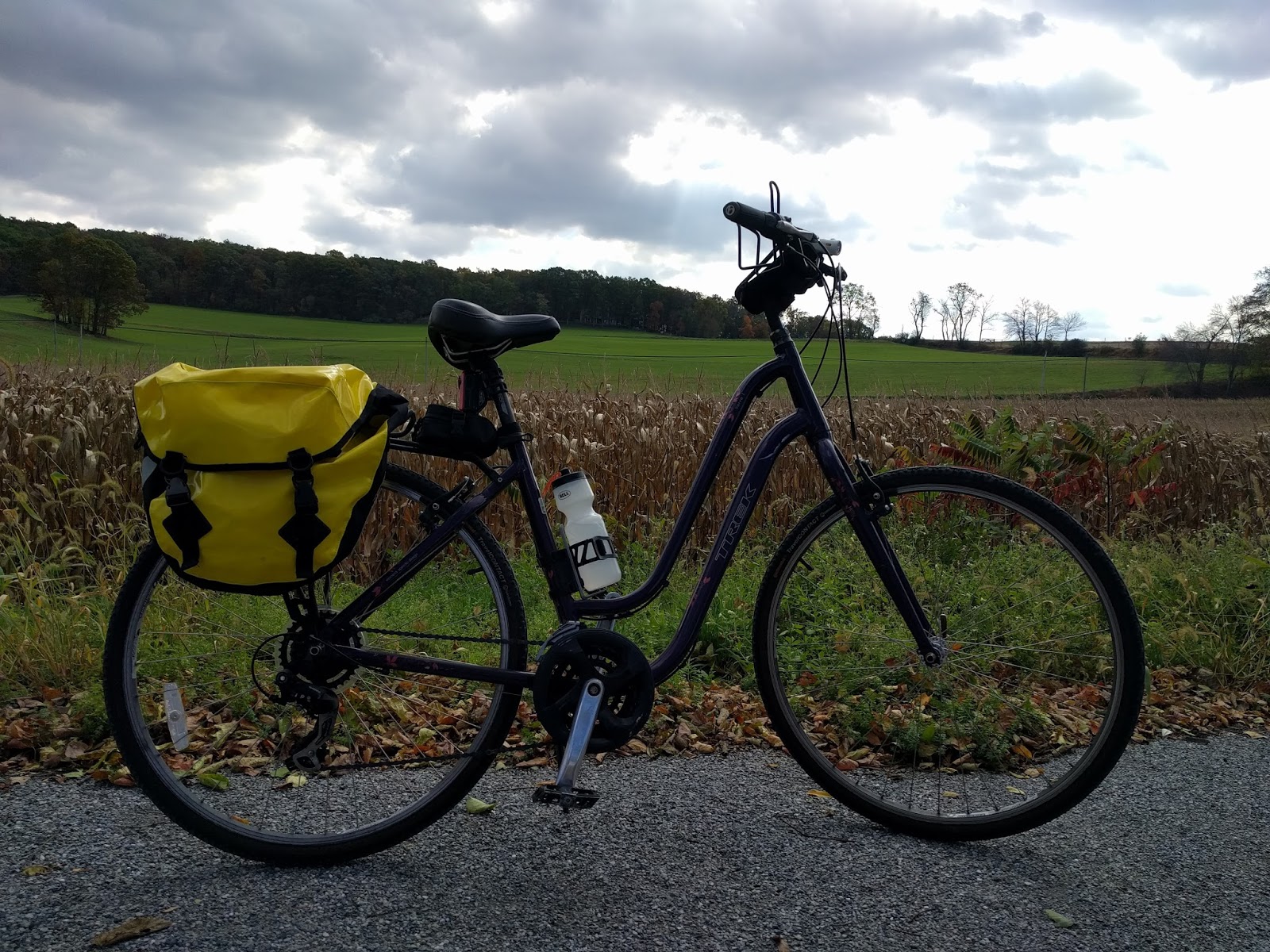
When I first met her, I thought she was beautiful. I didn't know what kind of bicyclist I would be. Roads? Trails? Three miles a week, or more than that? I didn't know. But this bike... She was purple, with a step-though frame, and flowery vines painted on. Anyone who saw this bike would know it was a woman's bike, no question.

Few things give me as much joy as dismounting. I slow way down, pull one leg through the frame to sit side-saddle, then hop off and start walking. I imagine that I'm a slip of a girl - light and lithe, like a fairy princess - gently tripping along the ground. I always stick the landing, but... Well, at 5'9" and almost 200 lbs, I am nothing like a fairy princess.

I started taking longer and longer rides, working from "Whew! Three whole miles!!" to a 7-mile commute, then a 10-mile weekend ride, then 20 miles, then 30, and then I did a metric century (100km, or 62 miles). I started biking to work, and got panniers to put on her rack so I could carry my work clothes and towel - yes, my commute is far enough that I have to shower when I get there.
Gradually, I came to realize this was the wrong bike for most of what I do. She's heavy and bulky. And while her geometry allowed me to bike in a dress and maintain some modesty, it's not even slightly aerodynamic. I knew I needed a road bike - something faster, with more room at the top of the gears. But I loved my step-through frame. No road bike would have that, and I was bummed that I'd have to give it up.

My marvelous local bike store (Crofton Bike Doctor) set me up with a bike someone had traded in - a Specialized Ruby. A carbon frame with a nearly horizontal crossbar, pedals you have to clip into, and drop-down handlebars like a ram's horns. She's not a very girly color. But she is slender, and light, and nimble. And she's fast and strong. This bike wants to go uphill. She wants to beat the motorized vehicles on the downhill... and she gets much closer than my hybrid ever did.

With my hot pink helmet, my hot pink-trimmed biking shoes, and all the flowery, girly-colored spandex I can find, I think we're still feminine enough.

Monday, May 22, 2017

It's Different When They're Yours

"How was your day?" I asked my 14-year-old, as I settled into my chair.
"Meh." She shrugged and I sighed. Right. Open-ended questions.
"How was your commute?" We both ride our bikes to get where we're going. I do so when the weather's nice and it's not too much of an inconvenience. She does it every day, unless we offer her a ride in the car. That doesn't happen often. For her, biking means freedom and speed.
"Oh, my God! I was coming up to this crosswalk, so I slowed down, and this guy in his car on his phone almost..." I had opened the floodgate.

I pasted what I hoped was a mildly concerned look on my face as I listened to her talk about her near-miss. Some one wasn't paying attention and got way too close, drawing the ire of the crossing-guards and a lecture. I reviewed traffic patterns with her - people biking are safest when they behave in traffic like people driving, but that can be difficult to do if you've never driven. She was where she should have been, doing what she should have been doing. It was like any other near-miss, only it wasn't, because it was my daughter.

I knew a few things immediately. 1) No, I couldn't go kill someone. 2) Of course she would ride tomorrow (I reminded myself that this was a good thing). 3) We couldn't tell my husband.

When I started biking more, I would come home after a ride, still hopped-up on adrenaline. My husband would ask how my ride was, and I would recount all the details of whatever incident could have put me in the hospital, but didn't.

I should tell you, my husband is an avid runner. He's had his own near-misses. He's supportive of my biking to a fault; he knows how important his running is to him. He also knows about drivers and attention and infrastructure for anything other than cars.

I would watch his face as I vented my anger at the person driving. The carefully controlled, mildly concerned expression, the shrug, and the "Yeah - drivers. You'll have that" comment. I could tell, though, that he didn't like it. I had put him in a tough spot. He couldn't tell me not to ride; he knew riding on the sidewalk wasn't an option for me (it's not legal here and is rarely a safer, much less a more enjoyable option); and yet...

Eventually I stopped sharing my stories. If pressed, I'd say something like, "I just need to review some footage from my ride." I ride with a Fly6 - it captures video of things going on behind you while also acting as one of the best tail-lights I've ever seen. Sometimes, the close-call isn't as bad on video as it was when you were riding. Or that's what you can tell yourself.

How can you protect the people you love and allow them their freedom? Where's the balance point?

When my daughter turned 15, she started a new job about three miles away. She could ride her bike, though, unlike her route to school, her route to work would take her along some of the busier streets. I upgraded her lights. We talked about the importance of paying attention and route options.

Her dad said we'd drive her home at the end of her day. I insisted her lights were good enough. He insisted we'd pick her up. As the days got longer, I insisted that it wouldn't even be dark when her shift ended. He insisted we'd give her a ride.

Her birthday isn't until the winter. But maybe, for my birthday, I can get her her own Fly6. Maybe the newer, more expensive, front-facing Fly12 to go with it.

Friday, September 2, 2016

A Lesson in Control and Release

I found myself praising my daughter for learning a lesson in lane control and release, but it was really that she taught me the lesson. (Spoiler alert; no daughters were harmed in the making of this blog post.)

Most sites seem to call this "lane control" rather than "control and release," but what often happens over the course of a ride is both control and release. A person on a bicycle takes the middle of the right lane - rather than riding on the very outside edge - in order to control traffic behind them. When the lane widens, or a shoulder or bike lane are added to the lane, the person on a bicycle can move over to allow traffic behind them to pass safely.


In Anne Arundel County, bike lanes, shoulders, choke-points, and narrowing occur at random. The bad news is that people on bicycles sometimes have to take an aggressive stance to prevent people in automobiles from trying to "squeeze by." The good news is, it probably won't be long before the bike lane or shoulder magically reappears. (This is all bad news for people on bikes, who don't appreciate disappearing bike lanes or random choke points like the one below.)


An example of an AA County choke point. It's supposed to "calm traffic," but doesn't actually impede automobile traffic in any way, and is the opposite of "calming" for people on bicycles.

One road in particular tends to suffer from narrowing and widening lanes, as well as drivers in a hurry. In places, the shoulder can be measured in millimeters, while in other places there's a shoulder wide enough that it might be another lane (though it isn't marked as such). In much of the road, the lane is too narrow to safely be shared, but just wide enough to be tempting.


It was in this section that my daughter tried - unsuccessfully - to control the lane. She was passed by people in cars trying not to cross the double-yellow, because there was oncoming traffic.

When I bike this road, I always remind myself to put on my big-girl pants, steel myself, and take that lane. People in cars on this road will always try to share the lane with me if I don't take all of it, and that's a pretty bad situation for a person on a bike to be in. (Check out that first link in this post. No, really. It won't take long, I promise. Here it is again.)

My daughter's experience is one I've had. While I was busy clucking my tongue that she had to learn that lesson the hard (thankfully, not the hardest) way, I forgot that I was still learning it, too. Sometimes it's helpful to hear someone you love talk about a shared experience. It's a reminder to do what you need to do to stay safe, and validation that you need to do it. Thanks, Daughter.

Saturday, January 30, 2016

On the Narrow-Highway Exception to Maryland's 3-Foot Law

This is the letter I just wrote to Senator Jim Rosapepe and delegates Barbara Frush, Ben Barnes, and Josaline Pena-Melnyk about the need to get rid of the narrow highway exception to Maryland's 3-foot law. BikeMaryland's article outlines it pretty well, but it's important for individuals to speak out, in addition to the wonderful work being done by BikeMaryland and BikeAAA.

Dear Senator Rosapepe,

Getting rid of the narrow-highway exception to the 3-foot law will protect bicyclists in the short and long term, and help to defuse the tension between the bicycling community and the driving community.

My route to almost everywhere requires me to ride on Annapolis Rd between Arundel High and the traffic circle, then on Odenton Rd between the traffic circle and the MARC station.

Both of these roads fall under the "narrow highway" exception for bicyclists. Vehicles aren't obligated to give me a safe passing distance, and usually don't. Both the high school and the MARC station are destinations one would expect for bicyclists traveling to school or work.

As a motorist, I am aware of the inconvenience to motorists by the presence of a bicyclist. As a result, I prefer to ride to the right of the lane, so that motorists can pass when it is safe. When motorists pass too close - as the current law allows - I ride in the middle or left portion of the lane. Preventing motorists from passing too close is safer in the short-term, but I worry about the ill-will it engenders.

As a cyclist, I need the protection of the 3-foot law. I need to know that motorists will respect my need for safety by waiting until they can leave a safe passing margin, and that I don't have to take actions which would seem aimed at angering drivers in order to achieve my short-term safety.

Getting rid of the narrow-highway exception to the 3-foot law will protect bicyclists in the short-term and in the long-term, as motorists learn that leaving a safe passing margin is not the "polite" thing to do, but the legal thing to do.

When motorists understand that laws prioritize bicyclists' safety, they will be less likely to take cyclists' presence on the roads as a personal affront. They will be less likely - I think - to succumb to rage against an individual cyclist. Getting rid of the narrow-highway exception will be good for motorists and cyclists.

Thank you for your consideration of this important issue.

In peace,


Jennifer A. Carson

Saturday, October 24, 2015

The Big Deal About Some Washington, D.C. Bike Lanes

If you're following me on Facebook, you've already seen most of this. This post lays out the background information, both sides of the argument, and my stance in it.

The Current Situation:

There are bike lanes all around this piece of Washington, D.C., but few that connect the areas with a lot of bike lanes to the areas with few bike lanes, and fewer continuous north-south bike lanes nearby. The marker is for New York Ave. and 6th street, northwest. Solid lines are bike lanes, dotted lines are "bike-friendly streets" - places where Google has noted there are bicyclists, though I question their equation of large numbers of cyclists to "friendliness." 6th street is like a bike-lane desert.

In 2014, 12 bicyclists and 16 pedestrians were hit along the stretch of 6th street under consideration, and 14 bicyclists and 7 pedestrians were struck along the portion of 9th street under consideration, according to FOIA data cited by the Washington Area Bicyclist Association (WABA). So, bicyclists and pedestrians do use the street, but not safely.

On 6th street and M street (jut north of the marker on the above map) is a large church of long-time congregants, the United House of Prayer. The New Bethel Baptist Church is at 9th and S. Northwest D.C. has seen a lot of gentrification.

The United House of Prayer enjoys street parking, where about 75 cars can park diagonally on Sundays. The proposed changes to 6th street would allow only parallel parking, meaning the loss of an unknown number of parking places.

The Proposals:

There are four proposals for adding bike lanes to either 6th or 9th streets in northwest Washington, D.C. They all allow for some street parking, at least at "non-peak" times, which would presumably include Sunday mornings.

Here's my favorite proposal, which provides for protected bike lanes in each direction, two or four lanes of travel (four in peak times), and 2 lanes of parking during non-peak times. The plan for 6th street north of New York Avenue looks the same as this, which shows 6th south of New York Avenue:

The Conundrum:

Gentrification has forced many of the congregants to the suburbs. The churches may see a concerning situation where congregants are far from their church and have trouble parking once they get there. They are arguing that this loss of parking impinges on their freedom of religion.

The city has adopted Vision Zero, which aims to eliminate traffic deaths. Protected bike lanes are a major portion of this vision.

The Washington Area Bicyclist Association (WABA) asserts in their post on the recent public meeting that while concerns about gentrification are valid, using the proposed bike lanes as a proxy for this argument is inappropriate.

My Stance:

As Christians, we are told to protect the vulnerable. This extends to vulnerable street users, such as bicyclists and pedestrians. The benefit of being "strong" (in the majority, supported by your environment, and physically secure) is that you can afford to help the weak. As Christians, we are commanded to do so, even at the expense of our comfort.

As Christians, we are told that we are the stewards of our environment. While biking isn't free from environmental harm (tires are a petroleum product), it is more responsible than driving. As Christians, we should be encouraging bicycling and walking as means of transportation.

As Christians, we are told to love one another, above all else. The importance of community and inclusiveness is reinforced through scripture. Our public policies and behaviors should reflect these values.

Unfortunately, the behavior of the those representing the churches at the public meeting did not represent Christian values. Besides holding their right to park above others' right of physical safety, they shouted down and cat-called opposing viewpoints.

I hope that should my church find itself in a similar situation, that we will demonstrate the Christian values we claim as our own.